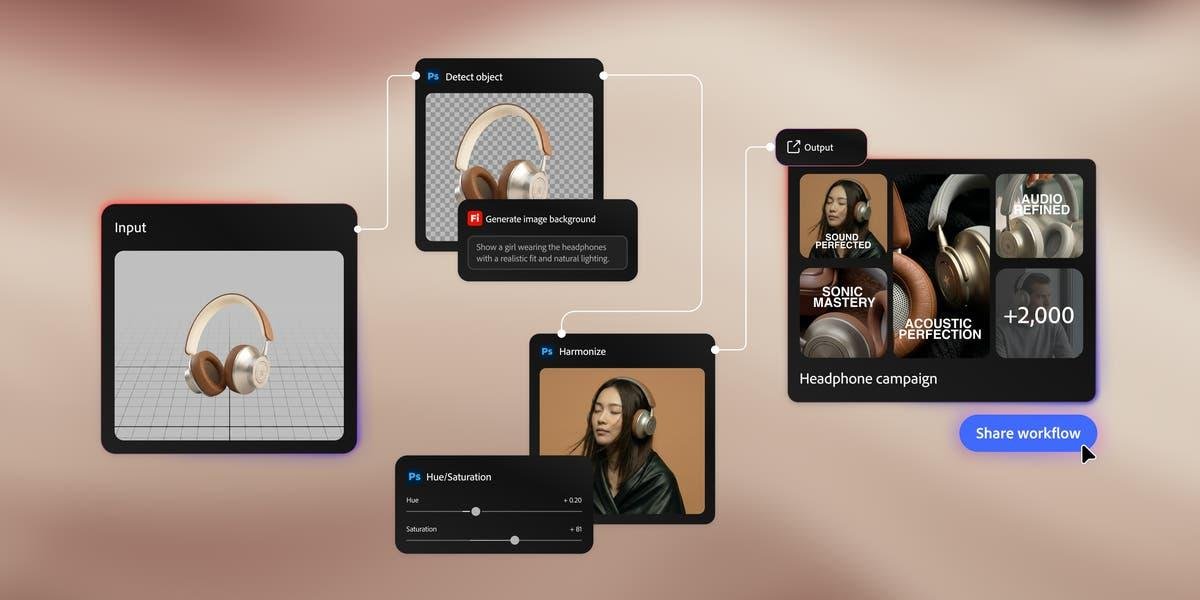
Adobe MAX 2026 sold a future where creatives direct and machines execute. But the most important detail wasn't on stage: Photoshop has started moving beyond Photoshop.
For years, Adobe treated AI as just another button inside its apps: fill, expand, remove. In Miami, from November 10 to 12, that logic was turned upside down. AI is no longer just a tool. It's becoming the one operating the tools. And those tools are starting to respond to agents that aren't even made by Adobe.
For anyone working in art direction, design, or production, it's worth looking beyond the feature list.
What Was Announced, in Short
Firefly is being rebuilt as an AI creative studio: you describe a goal in natural language, and an agent coordinates the tools and models needed to get there. According to Adobe, users can review the agent's plan before execution, choose which model to use, and step in at any point (Creative Bloq).
Photoshop Without Photoshop
The week's most underrated announcement was MCP. Essentially, Adobe is opening up a local server that gives chatbots like ChatGPT, Claude, and Gemini access to features in Illustrator, Photoshop, After Effects, and Premiere (TechCrunch). In other words, your PSD file could be edited by an agent you're talking to outside Adobe's ecosystem.
Even Adobe doesn't fully know how far this will go. Deepa Subramaniam, an Adobe vice president, told TechCrunch: "We are still figuring out where and when and how to draw the line."
Moving in the same direction, Adobe's expanded partnership with Google brings its tools into Workspace, Gemini, and Google's AI Mode in Search. Adobe and Google DeepMind will also jointly develop new AI-powered editing capabilities, starting with Photoshop (Adobe). Creative Bloq interpreted the move this way: rather than expecting creatives to work exclusively inside Adobe apps, the company wants its tools to be available wherever people already are (Creative Bloq).
t's a fundamental shift in the model. Photoshop is no longer just a place you go to work. It's also becoming a service that other software can call upon.
The Stage Has a New Audience
MAX has always been an event for individual creatives. This year, the spotlight shifted toward AI-orchestrated creative work inside large organizations, with creatives positioned as collaborators within a much bigger process. Analyst Phil Wainewright sees this shift as deliberate, designed to serve Adobe's largest enterprise customers, even if independent creatives end up feeling left behind (Diginomica).
Brand Intelligence reveals just how ambitious this vision is. The tool builds a "brand ontology," analyzes visual and textual signals through computer vision, and continuously learns from internal feedback and social listening. In practice, it's software trying to learn something that currently lives inside the mind of a senior art director.
The broader context helps explain the urgency. Adobe is changing CEOs on December 1, when Anil Chakravarthy takes over with a stated focus on "agentic software" (The Logical Indian). Meanwhile, competition is intensifying on both sides. Canva and Figma are investing heavily in AI, and in October, a solo developer released free, open-source clones of seven Creative Cloud apps built using AI (PetaPixel).
What Remains Unclear
Creative Bloq raised some important questions:
- Who makes the decisions? The promise that artists remain in control makes sense when agents handle filing, resizing, and quality checks. It becomes less convincing when they start making decisions about composition, layout, and style.
- Does it actually save time? Adobe still needs to prove that automation frees up more time for creativity, rather than simply accelerating production.
- Can you opt out? For creatives who want to avoid AI, that becomes increasingly difficult as more apps introduce agents.
- What about ethics? With models from Google, OpenAI, Kling, and ByteDance integrated into Firefly, Adobe's reputation for "ethical AI" becomes harder to defend. That's the subject of article #01.3.
Pricing and credit consumption for the new agents were not detailed in the event coverage.
What This Means for Creatives
- The brief becomes the interface. If agents execute tasks based on natural language, writing a strong brief — with clear criteria, references, and constraints — becomes a production skill, not just an account management responsibility.
- Brands need to be machine-readable. Tools like Brand Intelligence will evaluate creative work based on what they can interpret from a brand's identity. Well-documented design systems become more valuable, while creative intuition that has never been articulated becomes a disadvantage.
- The file becomes an API. With MCP, layer organization, naming conventions, and file structure stop being matters of personal preference. They become what enables — or prevents — an agent from working on your project.
- The real value moves up a level. If execution becomes cheap, the value shifts toward what machines still struggle to do well: choosing, editing, knowing when to say no. Art direction, in the most literal sense of the term.
Adobe MAX 2026 made the company's direction clear.
Fontes
- Creative Bloq: o Firefly agora é um estúdio criativo (10 nov 2026)
- TechCrunch: Adobe adiciona mais IA e lança um MCP (10 nov 2026)
- Adobe: parceria ampliada com o Google (10 nov 2026)
- Creative Bloq: a parceria com o Google e o futuro do Photoshop (10 nov 2026)
- Diginomica: o foco sai do criativo individual (11 nov 2026)
- The Logical Indian: Chakravarthy assume como CEO
- PetaPixel: clones gratuitos da Creative Cloud feitos com IA (7 out 2026)